Key Logistics at a Glance
The Legend of the 'Second Most Beautiful Grotto in Vietnam'
Tucked against the sheer karst cliffs of Nham Mountain just 2.8 kilometers southwest of Tam Cốc Pier, Bích Động Pagoda (Chùa Bích Động) remains one of the most spiritually enchanting sanctuaries in northern Vietnam. Built in 1428 during the early Hậu Lê Dynasty, this ancient tiered temple was bestowed the title "Nam Thiên Đệ Nhị Động" (The Second Most Beautiful Grotto under Southern Skies) by Lord Trịnh Sâm in 1774, ranking second only to Hương Tích Cave in Hanoi.
What makes Bích Động an architectural marvel is its seamless integration with the limestone mountain: rather than standing as a single structure, the pagoda is tiered into three separate sanctuaries that ascend directly into the karst cavern system.
Exploring the Three Levels: Hạ, Trung & Thượng Pagodas
Your journey through Bích Động involves climbing a succession of moss-covered stone stairs carved into the rock face:
Chùa Hạ (Lower Pagoda)
Constructed at the mountain base in a traditional 5-bay layout with colossal ironwood pillars and intricate stone pedestals. It radiates incense warmth and houses altars dedicated to Buddhist deities.
Chùa Trung (Middle Pagoda)
Ascend 22 stone steps along the cliffside to reach this cavernous sanctuary. Half of the pagoda rests outdoors while the altar sanctuary extends deep into the naturally lit limestone cave chamber.
Chùa Thượng (Upper Pagoda)
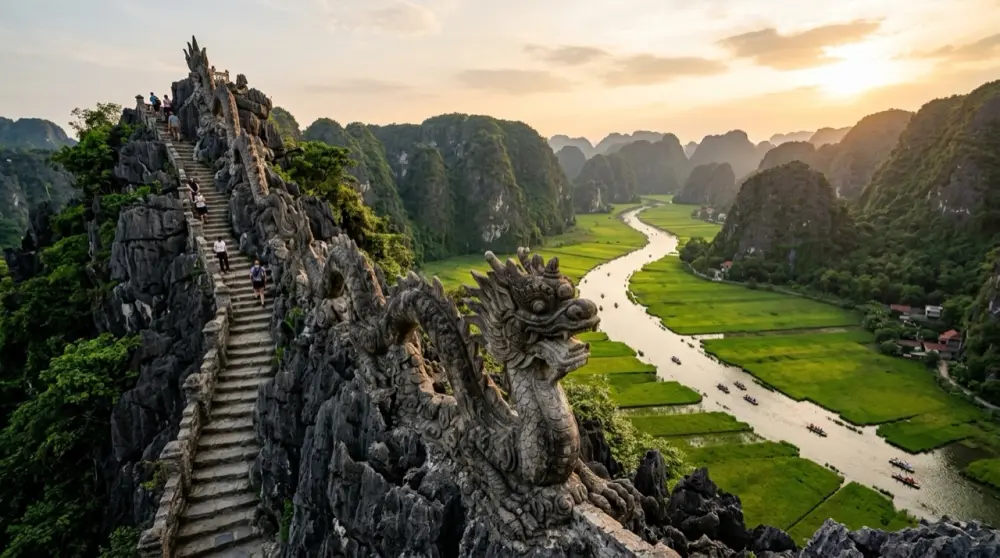
Climb another 40 steps through the dark cavern of the Dark Cave (Động Tối). Step out onto the highest limestone balcony for an unforgettable panoramic sweep over lotus lagoons and jagged karst peaks.
Master Photography Guide: Angles, Golden Hour & Lotus Season
Bích Động is one of the most photographed temple gates in Southeast Asia. To capture magazine-caliber imagery without tourist obstruction, follow these resident photography guidelines:
- The Iconic Stone Bridge Gate Shot: The classic composition captures the curved stone bridge crossing the expansive lotus pond leading straight to the mossy tiled three-tiered gateway. Best timing: 06:45 AM - 08:00 AM when morning sun strikes the eastern ridge and illuminates the green water reflection.
- Summer Lotus Bloom (Late May - Early July): During these 6 weeks, the moat surrounding Bích Động bursts into thousands of pink lotus flowers (Hoa Sen) and fragrant broad green leaves, elevating photos with rich vibrant color contrasts.
- Dark Cave Silhouette: Inside Động Tối between Middle and Upper Pagoda, shoot back toward the cavern openings to create dramatic natural frame-in-frame compositions against the jungle canopy outside.
How to Get There, Dress Code & Parking Tips
Getting to Bích Động is one of the easiest and most enjoyable excursions in Ninh Bình:
| Transport Mode | Transit Time | Cost (2026) | Local Experience Rating |
|---|---|---|---|
| Bicycle | 12 - 15 minutes | Included free with most homestays (or 40k VND/day) | ⭐⭐⭐⭐⭐ Scenic flat countryside roads with zero hills |
| Scooter / Motorbike | 5 minutes | 100,000 - 150,000 VND / day rental | ⭐⭐⭐⭐ Convenient if combining with Thung Nham |
| Walking / Stroll | 35 - 40 minutes | Free | ⭐⭐⭐ Peaceful during early morning or sunset |
Frequently Asked Questions
Is there an entrance fee to visit Bích Động Pagoda in 2026?
No, entrance to Bích Động Pagoda is completely free of charge. You only need to pay a modest parking fee (usually 10,000 to 20,000 VND) if you bring a bicycle or scooter.
What is the best time of day to avoid crowds at Bích Động?
The ideal window is between 6:30 AM and 8:30 AM before tourist minivans arrive from Hanoi, or late afternoon from 4:30 PM to 5:30 PM just before dusk.
Can I combine Bích Động with Thung Nham Bird Valley?
Yes! The road passing Bích Động continues directly toward Thung Nham Bird Valley (approx. 4.5 km further). A popular day loop is visiting Bích Động early morning, cycling to Thái Vi Temple, having lunch in Tam Cốc, and finishing at Thung Nham for the 4:30 PM sunset bird arrival.