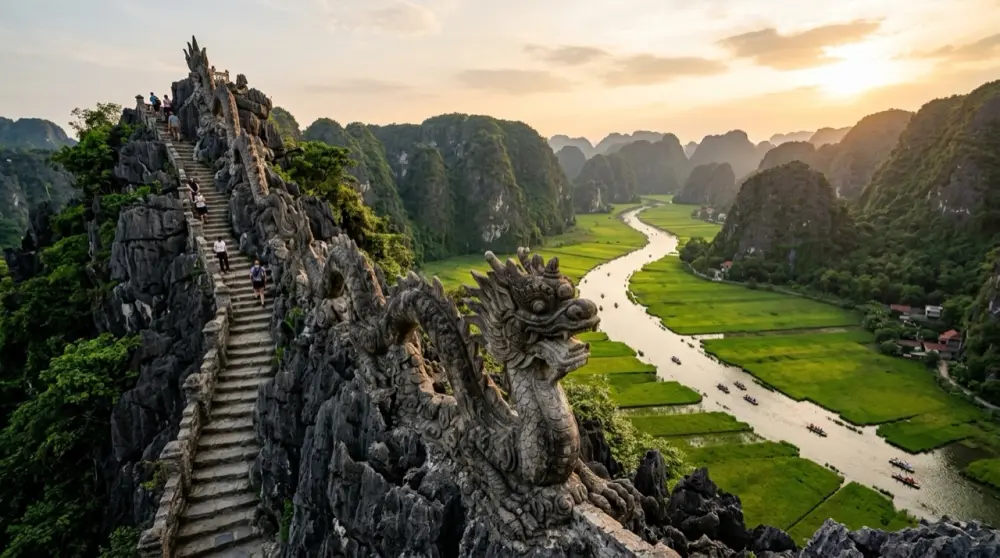
1. Hang Múa Dragon Peak (The Panoramic Epic)
Best Time: 06:15 AM – 07:30 AM (Sunrise) or 05:00 PM – 06:00 PM (Sunset).
Recommended Lens: 24–70mm standard zoom + 16–35mm ultra-wide.
Position yourself slightly below the carved stone dragon on the ridge line. At sunrise, the light breaks over the eastern delta, casting long shadows behind the jagged mountain teeth. Frame the carved stone dragon in the foreground with the serpentine curves of the Tam Cốc river snaking through the valley below.
2. Bích Động Pagoda Arch Bridge (The Lotus Classic)
Best Time: 07:00 AM – 08:30 AM (Soft directional light).
Recommended Lens: 35mm or 50mm prime.
The stone bridge leading across the lotus lake to Bích Động's ancient three-tiered wooden gate is iconic. In June and July, the entire lake is covered with pink lotus flowers. Stand at a 45-degree angle to the bridge to capture the reflection of the ancient tiled gate in the water.
3. Tam Cốc Rice River (The Agrarian Masterpiece)
Best Time: Late May to early June (during harvest), 03:30 PM – 05:00 PM.
Recommended Lens: 70–200mm telephoto.
From inside your sampan, shoot low to the water level. Use a telephoto lens to compress the layers: golden yellow rice stalks in the foreground, local rowers pushing oars with their bare feet in the midground, and towering sheer karst cliffs in the background.
4. Hành Cung Vũ Lâm in Tràng An (The Regal Water Reflection)
Best Time: Morning around 08:30 AM (on Tràng An Route 3).
Recommended Lens: 24–70mm with a Circular Polarizing filter (CPL).
This wooden floating pavilion sits in the center of a glass-like karst lagoon. A circular polarizer cuts surface glare on the water, revealing emerald green underwater vegetation swaying below the reflection of the pagoda roof.
5. Drone Regulations (UAV) in Ninh Bình
Vietnam strictly regulates drone flights. Flying over historical monuments like Hoa Lư temples or government administrative buildings in Ninh Bình City is forbidden without permits.
However, respectful flying over open rice paddies along the Tam Cốc countryside backroads early in the morning is generally tolerated by local farmers provided you do not fly low near crowds, boat docks, or nesting birds at Thung Nham.
Local Insight: Handling High Contrast Karst Scenes
Because the limestone mountains rise abruptly 100+ meters above flat valleys, contrast between bright skies and deep mountain shadows can be extreme. We always recommend shooting in RAW format and bracketing your exposures by 1 to 2 stops, especially when shooting toward the sunset at Hang Múa!